A pyrocumulonimbus (PyroCb) formed over intense wildfires in France: Extensive media response to LSC BioSmoke’s research
Amid this year’s wildfire season in Southern Europe, the first pyrocumulonimbus (PyroCb) ever observed in France likely formed on July 25, 2026, during intense wildfires near Bordeaux in south-western France. PyroCbs are fire-induced thunderstorms, sometimes referred to as “fire storms”. To date, they have only been rarely observed in Europe, e.g., in Portugal in 2017, but have occurred more frequently in Australia, North America and Siberia in recent years. They can transport large amounts of smoke aerosol into the stratosphere at altitudes of around 10–12 km, where they can remain for extended periods and potentially influence the global climate.
To better understand this process, the conditions under which PyroCbs form are being investigated as part of the LSC BioSmoke project through model simulations by Jason Müller, a PhD student at the Leibniz Institute for Tropospheric Research (TROPOS) in the department of “Modelling of Atmospheric Processes”. The exceptional wildfire activity with the formation of a PyroCb led to significant media interest at the end of July. TROPOS was contacted by several journalists and media agencies and in particular Jason Müller gave several interviews such as with the German Press Agency (dpa), which subsequently issued a press release that was picked up by numerous German-language media outlets.
TROPOS subsequently received further inquiries from major German media outlets, many of which addressed the role of wildfires and the related emissions of smoke on atmosphere and climate. Scientists from the LSC BioSmoke, in particular Benedikt Gast, Dr. Yarê Baker and Dr. Robert Wagner, provided expert statements on smoke transport, its chemical composition, and its atmosphere-climate-interactions together with current research priorities. Their statements were also featured by numerous media outlets, partly also from international media. Furthermore, we were contacted from the German Insurance Association for further advise regarding the potential risk of PyroCb formation in Germany.
In early August, the fluorescence lidar applied within the LSC BioSmoke project by TROPOS Remote Sensing Department detected some smoke layers at altitudes of 7–10 km above Leipzig. The smoke likely originated from the French wildfire region, suggesting that the formation of a PyroCb may have contributed to its transport into the upper atmosphere. TROPOS issued a press release on August 4 highlighting these observations and featuring comments from LSC BioSmoke researchers, which received considerable media attention.
When strong forest fires intensified across Central Europe in mid-August 2026, with notable events occurring near the German border causing notable smoke plumes affecting the air quality of western German cities, the research of LSC BioSmoke was again highlighted in the media. This time, the focus was on the spread of wildfire smoke and its health impacts. For expert insights, Dr. Yarê Baker from the TROPOS "Atmospheric Chemistry Department", whose work involves studying the chemical composition of smoke, was consulted for media statements, including audio statements in a German science podcast.
The exceptionally severe wildfires in Europe in summer 2026 have once again demonstrated the importance of research of wildfire smoke and their consequences for atmosphere, biosphere and climate. The strong media response also highlights the need for scientific analysis of these complex interactions. Through numerous press inquiries and interviews, LSC BioSmoke was able to demonstrate its collective expertise and highlight the relevance and urgency of its research.
As a result of global warming, the risk of wildfires in Europe is expected to increase further. Consequently, the effects of smoke and other wildfire emissions on the atmosphere, climate and regional air quality are becoming increasingly important. LSC BioSmoke serves as a center of expertise in this field, contributing to a better understanding of the underlying processes and providing an important scientific basis for addressing future extreme wildfire events.
New BioSmoke Newsletter Available
The second edition of the BioSmoke newsletter (June 2026) is now available. This issue includes a report on the 1st Smoky Day, updates on current research activities, upcoming events, and other developments within the project.
The newsletter can be downloaded as a PDF here (7.2 MB).
Mini hackathon at TROPOS
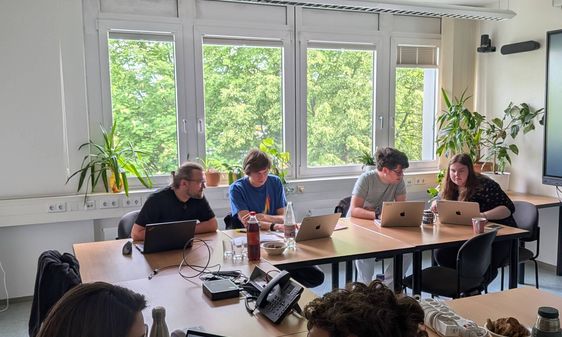
In the lead-up to the annual HAMMOZ user workshop, which took place at TROPOS on 21–22 May 2026, a one-day mini hackathon was organised as a joint activity between the LSC BioSmoke and the European Horizon Project CleanCloud (Clouds and Climate Transitioning to a Post-Fossil Aerosol Regime). The event brought together seven participants from TROPOS and the Leipzig Institute for Meteorology. The mini hackathon focused on applying the recently developed regional aerosol model, ICON-HAMlite-LAM (see Heinold et al., 2026; doi: 10.5194/gmd-19-6167-2026 for details). This included testing and improving existing documentation and workflows, analysing and consolidating ongoing software development, and evaluating different fire emission datasets for potential future applications, both within and beyond the LSC BioSmoke.
The event provided an excellent opportunity for knowledge transfer, characterised by a highly collaborative atmosphere and strong enthusiasm, which helped strengthen cooperation between the groups involved and lay important groundwork for future joint developments.
The LSC 'BioSmoke' at the EGU 2026
Several members and affiliated researchers of the LSC 'BioSmoke' attended this year's general assembly of the European Geosciences Union (EGU), that took place from 3-8 May 2026 in Vienna, and presented their current research projects with respect to the various aspects of smoke research. A list of these presentations can be viewed in the selected programm.
Johanna Roschke won poster prize at the ACTRIS Science Conference
Johanna Roschke, a PhD student in Heike Kalesse-Los' group at the Leipzig Institute for Meteorology, participated in the ACTRIS Science Conference in Oslo (20–23 April 2026) together with other researchers from the LSC BioSmoke. She presented a poster on her current research project, TRAILS (Trajectory-based Identifica-tion of Lofted Smoke), which is a novel framework for the continuous identification of smoke at different times and heights. She developed this framework as part of her PhD project within the LSC BioSmoke. Her poster was well received and was awarded the best student poster prize at the conference.
TRAILS combines FLEXPART trajectories with passive satellite observations, and its performance was evaluated using independent fluorescence lidar observations to identify long-range transported wildfire smoke from North America over Leipzig. Further details are available in the preprint by Roschke et al. on EGUsphere: https://egusphere.copernicus.org/preprints/2026/egusphere-2026-718/
Smoky Day 2026
From March 30 to April 1, 2026, the first edition of the conference “Smoky Day” took place. It was organized by the Leibniz ScienceCampus (LSC) “BioSmoke” and combined the third project meeting of the LSC with a scientific workshop to stimulate exchange with the international scientific community.
During the three-day interdisciplinary workshop, more than 50 researchers came together to discuss various aspects of atmospheric smoke and other fire-emitted aerosol particles, ranging from emission and transport to interactions with clouds.
The program can be downloaded here.
In total, participants represented 15 different institutes and 9 countries, presenting their latest findings related to smoke from vegetation fires through talks and poster presentations. The range of work included laboratory combustion experiments, field studies, as well as modeling and remote sensing approaches.
The first day began with a short introduction to the BioSmoke project. This was followed by a keynote lecture by Martin Bauch from the Leibniz Institute for the History and Culture of Eastern Europe (GWZO), offering an insightful perspective on how atmospheric aerosol events were described in the 15th century. This talk sparked a lively discussion about which aerosol particles may have been responsible for the “blue sun over Naples” in the 15th century.
The scientific program then continued with 20-minute presentations. First, Finnish scientists Tero Mielonen and Annele Vitanen presented their work on boreal fires. After a coffee break, the poster session followed, where especially PhD researchers of the LSC BioSmoke had the opportunity to present their current work and discuss their results with external scientists.


The first day concluded with an evening visit to the Botanical Garden Leipzig. Prof. Christian Wirth, member of LSC BioSmoke and director of the Botanical Garden of the University of Leipzig, had prepared a special tour focusing on the different survival and protection strategies of plants exposed to recurring vegetation fires.
The second day focused entirely on scientific presentations, given by both LSC BioSmoke members and external participants. The morning sessions covered modeling of fire-induced emissions and their transport. After a coffee break, presentations addressed remote sensing approaches, focusing on the role of smoke in the troposphere and lower stratosphere. Further talks addressed the characterization and atmospheric transport of smoke particles, aging processes of aerosol smoke, and the presence of coarse aerosol particles in smoke plumes.
After another poster session, which was used for exchange between LSC BioSmoke members and external guests, the afternoon continued with additional talks. The day concluded with a keynote by Leda Kobziar from the University of Idaho, who joined online from the United States. She provided an overview of current research in pyroaerobiology and demonstrated how bacteria and other microorganisms can enter the atmosphere through vegetation fires and spread further.
The second workshop day ended with a short tour by Matthias Tesche, who presented various measurement instruments on the roof of the Institute of Meteorology. Some participants concluded the day with a joint dinner.


The third and final day of the “Smoky Day” began with further presentations on smoke transport and aerosol processes in the stratosphere. After a coffee break, an open discussion with all participants took place, focusing on current research questions, future developments, and potential collaborations.
A central topic was the definition of aged smoke particles, which is interpreted differently across research fields ranging from laboratory studies to remote sensing.
Overall, participants agreed that the workshop made a valuable contribution to fostering scientific exchange on atmospheric smoke and strengthening the position of LSC BioSmoke within the international research community. A continuation of the “Smoky Days” series is already planned for autumn 2027.

Second Project Meeting of LSC BioSmoke
The second project meeting of the Leibniz ScienceCampus (LSC) BioSmoke took place on 10–11 November 2025 at TROPOS. In addition to scientific exchange between the individual working groups within the LSC, other researchers presented their work in the field of smoke, fire, and biodiversity research. Among them were Rico Fischer from the Julius Kühn Institute and Ana Bastos from the University of Leipzig.
The two-day meeting began with an invited talk by Sergey Khaykin from LATMOS, who is also a member of the LSC Scientific Advisory Board. In his lecture, which was also open to the entire institute as a colloquium talk, he discussed the stratospheric impacts of wildfires over the past 21 years.
The remainder of the first day focused on status reports from the working groups and additional presentations, each accompanied by in-depth scientific discussions. The day concluded with a guided tour of TROPOS, including visits to the Aerosol Simulation Chamber of the Atmospheric Chemistry Department as well as the MARTHA Lidar system of the remote sensing division. Both facilities play an important role within the LSC BioSmoke and are used to study atmospheric smoke under laboratory conditions as well as in the free atmosphere.
The second day continued with reports from the work packages, with a particular focus on first results from the measurement campaign in Spain. The meeting concluded with an open discussion on future BioSmoke activities, as well as breakout sessions addressing specific topics such as the organisation of the “Smoky Day” and aspects of public outreach and internal communication between the different working groups.


First issue of the LSC BioSmoke newsletter published
In November 2025, the first issue of the LSC BioSmoke newsletter was published, which will now report regularly on the progress of the project approximately twice a year. Among other things, the first issue provides an overview of current research activities at LSC BioSmoke, such as a report on the measurement campaign in Spain, presents selected publications in more detail, and reports on other activities on campus. The report can be downloaded here (5.7 MB).
Seminar series of the LSC ‘BioSmoke’ implemented
The LSC ‘BioSmoke’ has started a regular seminar series that should bring together the expertise within the LSC and beyond. The first colloquiums talk will be largely held by members of the LSC by visiting the different involved institutes, before also international experts of the field are planned to be invited to Leipzig to further stimulate exchange and cooperation.

Aerosol Measurements during a Prescribed Burning Campaign in Spain
In October, a team from LSC 'BioSmoke' carried out measurements during a controlled fire-clearing campaign in Spain. The aim here is to gain a better understanding of the smoke emissions of different types of vegetation and to investigate how the physical and chemical properties of smoke aerosols change during their atmospheric transport and how they influence their radiation and cloud formation properties. The TROPOS backpack system was deployed to measure the physical properties of smoke aerosols, continuing its successful use in previous field campaigns. In addition, a set of low-cost sensor units was mounted on trees in and around the burning area to measure PM, CO₂, temperature, relative humidity, VOCs, and NOx indices. Filter samples were also collected for subsequent chemical and optical analyses.
This campaign was carried out in collaboration with Prof. Jorge de las Heras at the University of Castilla-La Mancha, Albacete Campus, who has extensive experience with prescribed-burning experiments. Prescribed burning is widely practiced in Spain to reduce fuel load and thereby prevent large wildfires. The burn location is roughly 100 km southeast of Albacete.. For scientific purposes, prescribed burning provides a controlled environment to study the characteristics of smoke aerosols. In this campaign, an area of approximately 1 km × 50 m was burned over two days, with each burn lasting around four hours. The TROPOS team successfully collected valuable datasets and filter samples. Preliminary observations show that PM₁₀ concentrations reached about 200 times the background level, while black carbon concentrations increased up to 3000-fold during the burn. Further analysis of these results will be presented in upcoming reports and publications—stay tuned. This was the first prescribed burning campaign within the BioSmoke project and provided substantial practical experience. The next campaign is planned for next year, and we are very much looking forward to continuing this work.


Successful kick-off meeting of LSC ‘BioSmoke’
The kick-off meeting of our LSC took place successfully on 13-14 February 2025 at TROPOS. All members of the BioSmoke campus came together for the first time and were presenting the activities that are planned within the work packages (WPs). Despite the members of the LSC, also other interested colleagues, mainly from TROPOS, joined the workshop, so that more than 30 participants exchanged knowledge regarding their current research projects about smoke, wildfires, and biosphere. The meeting started with a key note talk of Prof. Sebastian Lentz from the Leibniz-Institut für Länderkunde (Leibniz Institute for Regional Geography, IfL). As the speaker of the 2017 established LSC ‘Eastern Europe – Global Area, he provided valuable insights into the general aims of a LSC. Afterwards, all WPs presented the first steps of their research program and what they want to achieve within the 4 years of the first phase of the LSC. Each presentation was followed by an intense scientific discussion about possible collaborations within and beyond the Biosmoke project. The day ended with a guided tour through the DBFZ and a joint dinner there. The second meeting day covered more strategic discussions about the governance of the LSC including a strategy for public outreach. In the meantime, the PhD students and PostDocs of BioSmoke met and elected two PhD representatives. Further activities included the selection of the logo for our campus.


Scientific conferences
The members of the LSC attended several international conferences such as the EGU general assembly (28 April - 2 May) or the Europe Aerosol Conference in Lecce (1 – 5 Sept 2025).

New Leibniz Science Campus Conducts Research on Wildfires and Climate
How do wildfires affect the atmosphere and climate? This question is currently being addressed by the new Leibniz Science Campus “Smoke and Bioaerosols in Climate Change” (LSC BioSmoke), which launched in Leipzig in October 2024.
Under the leadership of the Leibniz Institute for Tropospheric Research (TROPOS), researchers from the University of Leipzig, the German Biomass Research Center (DBFZ), and the Helmholtz Center for Environmental Research (UFZ) are collaborating to gain a better understanding of the effects of wildfires.
The focus is on investigating smoke and bioaerosols produced by wildfires. Among other things, the researchers are analyzing their composition, dispersion, and changes in the atmosphere, as well as their effects on clouds, precipitation, air quality, and climate. To this end, they are combining laboratory and field experiments with ground- and airborne measurements, as well as model simulations.
In light of increasing periods of drought and the resulting rise in wildfire risk, the research conducted by LSC BioSmoke is becoming increasingly important. The Leibniz Science Campus will initially receive funding of approximately 900.000 euros per year for a period of four years. The goal is to better understand the complex interactions between wildfires, the atmosphere, and climate, thereby laying the foundation for more reliable climate forecasts.
For more Information: Press Release TROPOS March 2024